Browse Items (9335 total)
Sort by:
Cocoanut palms

Cocoanut palms in Dar es Salam. Houses of whites and houses of natives. Great mango trees in the back. Grass closely grazed by Indian humpbacked cattle. These palms are old - natural groves - not in rows. [Shantz travel journal, Apr. 2, 1920]
Cocoanut palms

Cocoanut palms in Dar es Salam. Houses of whites and houses of natives. Great mango trees in the back. Grass closely grazed by Indian humpbacked cattle. These palms are old - natural groves - not in rows. [Shantz travel journal, Apr. 2, 1920]
Cocoanut palms

Cocoanut palms in Dar es Salam. Houses of whites and houses of natives. Great mango trees in the back. Grass closely grazed by Indian humpbacked cattle. These palms are old - natural groves - not in rows. [Shantz travel journal, Apr. 2, 1920]
Cocoanut palms

Cocoanut palms in Dar es Salam. Houses of whites and houses of natives. Great mango trees in the back. Grass closely grazed by Indian humpbacked cattle. These palms are old - natural groves - not in rows. [Shantz travel journal, Apr. 2, 1920]
Cocoanut palms

Cocoanut palms in Dar es Salam. Houses of whites and houses of natives. Great mango trees in the back. Grass closely grazed by Indian humpbacked cattle. These palms are old - natural groves - not in rows. [Shantz travel journal, Apr. 2, 1920]
Betel nut, pepper leaf, tobacco
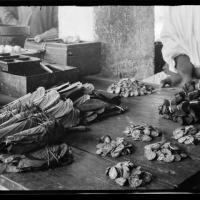
Betal nut (pawpaw), pepper leaf (tambu), tobacco - dry and powdered and dry [sic], chalk or lime (traka) and Gambia in try. Everybody seems to use this stuff. [Shantz travel journal, Apr. 2, 1920]
Bay
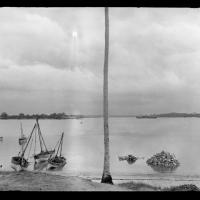
Panorama of bay at Dar es Salam. At right the church, Pandanus - heavy leaf purple fruited nut form a prominent part as street tree. Dock and dhows, British boat with cocoanuts on the opposite bank. R.R., shops, and steamer near entrance to the…
Bay
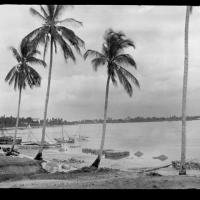
Panorama of bay at Dar es Salam. At right the church, Pandanus - heavy leaf purple fruited nut form a prominent part as street tree. Dock and dhows, British boat with cocoanuts on the opposite bank. R.R., shops, and steamer near entrance to the…
Bay
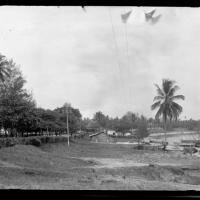
Panorama of bay at Dar es Salam. At right the church, Pandanus - heavy leaf purple fruited nut form a prominent part as street tree. Dock and dhows, British boat with cocoanuts on the opposite bank. R.R., shops, and steamer near entrance to the…
Cocoanut grove

Cocoanut grove with notches in the sides of the trees to enable the natives to climb the trees. House in back made of leaves and petioles. [Shantz travel journal, Mar. 31, 1920]
Two indigenous girls

A photograph of two small indigenous girls standing outside. The girl on the right has a hole in the side of her nose and braided hair. The girl on the left has three holes in the ear, two of them with plugs. Both of the girls are wearing dresses…
Cocoanut palms in street

Cocoanut palms in street in Dar es Salam. Tin can fence at left. [Shantz travel journal, Mar. 31, 1920]
Cocoanut palms in street

Cocoanut palms in street in Dar es Salam. Tin can fence at left. [Shantz travel journal, Mar. 31, 1920]
Cocoanut roof

Cocoanut leaf roof repaired with gasoline tins. Wall - rain - street, cocoanut, well and mangoes at the right. [Shantz travel journal, Mar. 31, 1920; this image forms a panorama with the previous one]
Cocoanut leaf roof

Cocoanut leaf roof repaired with gasoline tins. Wall - rain - street, cocoanut, well and mangoes at the right. [Shantz travel journal, Mar. 31, 1920; this image forms a panorama with the following one]
Cocoanut leaves used as fencing

Cocoanut leaves used as fencing. Braided and form a tight fence 8 ft. high. [Shantz travel journal, Mar. 31, 1920]
Beds

Beds. The type here and at Kigoma in places - here mat like ribband, Kigoma ox hides. [Shantz travel journal, Mar. 31, 1920]
Ochra, cucumber
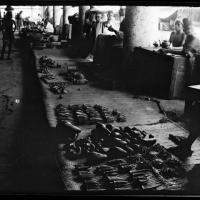
Ochra, cucumber, ochra, cucumber (brown skin), a fruit somewhat like tamarindus fruit. [Shantz travel journal, Mar. 31, 1920]
Cocoanuts in market

Cocoanuts in market. They are usually cut in half - drained and the hald sold dry for 4 hellers. 100 heller = rupee = 2 shillings. [Shantz travel journal, Mar. 31, 1920]
Market scene
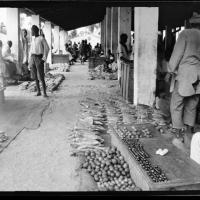
Market scene. Lemon, lime, tomatoes, eggs, fresh manihot, dry manihot in the back. [Shantz travel journal, Mar. 31, 1920]