Browse Items (9335 total)
Sort by:
Corn fields

Opposite side of track, looking over the corn fields. [Shantz travel journal, Mar. 28, 1920]
Looking back from train
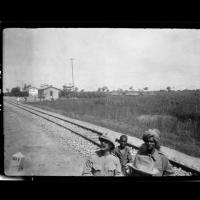
Looking back [down] the track - toward depot. [Shantz travel journal, Mar. 28, 1920]
Corn and native huts

Nssoke - Here there are a lot of plantings of corn and m'tama. Shows path in fore, corn with native huts - tall grass in the fore. [Shantz travel journal, Mar. 28, 1920]
Grass and dry forest
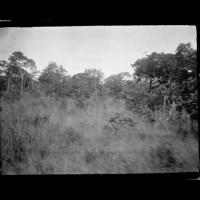
Back at side of track, shows grass and dry forest. [Shantz travel journal, Mar. 28, 1920]
General view
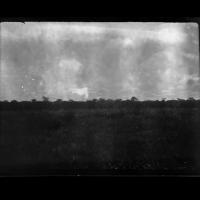
A general view - shows some M'tama - may not be good [image]. [Shantz travel journal, Mar. 28, 1920]
Depot

At depot in Tabora. In the fore - a mopane leaf pink flowered legume - long 6 inch hard pod, flour inside and relatively small seeds, a very pretty ornamental - also mango and oleander - and a home at left - rock border shows. [Shantz travel…
Andropogon and trees

Tall Andropogon with trees in the back. These ... photos are typical of the more open areas - it seems a little more sandy. But just beyond into dry forest of Elizabethville type. [Shantz travel journal, Mar. 28, 1920]
Andropogon

More Andropogon and less trees. [Shantz travel journal, Mar. 28, 1920]
General view of V.E. Payne's home
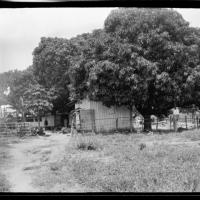
General view of Payne's home - grass in fore .... Close up showing mango trees in yard - fruit and cuttings taken from the first tree at the right of the path. [Shantz travel journal, Mar. 27, 1920]
General view of V.E. Payne's home
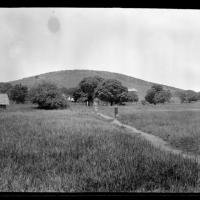
General view of Payne's home - grass in fore - has been a plantation, since the soil is ridged. Path leads to home. Tree at right was Empe oribo - from which cuttings were taken. [Shantz travel journal, Mar. 27, 1920]
Mango, manihot
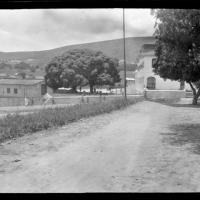
Mango, Manihot griz. [i.e., glaziovii] and the mango at the depot. Grass shrub hills in the back. [Shantz travel journal, Mar. 27, 1920]
Empe oribo trees
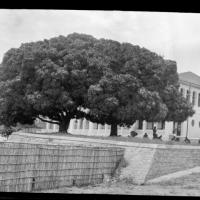
Two large Empe oribo trees with depot behind. These trees when they grow together take on the same form as one tree - except that they may be lengthened if they are far apart. [Shantz travel journal, Mar. 27, 1920]
2 large Empe oribo trees

Two large Empe oribo trees with depot behind. [Shantz travel journal, Mar. 27, 1920]
Empe toto & Empe oribo
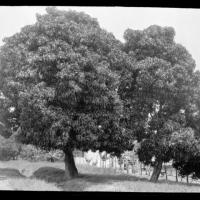
Empe toto at the right and Empe oribo at the left. Cuttings were taken from the tree at the right. Its leaves are a little broader but they are distinguished with great difficulty. [Shantz travel journal, Mar. 27, 1920]
Mango tree
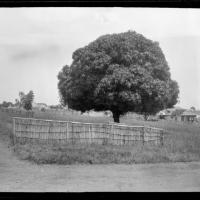
A mango tree, typical form, about 20 to 25 ft. tall. [Shantz travel journal, Mar. 27, 1920]
White ants

White ants at work on a pole - see mud tunnel - 6 ft. above the ground - also small holes plugged with mud. [Shantz travel journal, Mar. 27, 1920]
Papaya tree
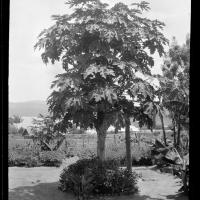
Papaya tree - much branched with fruit at the ends of the branches. [Shantz travel journal, Mar. 27, 1920]
View of V.E. Payne grounds

A view in the grounds of V. E. Payne (Kigoma, East African Agency). A walk bordered by banana, papaya and the large red bean vine. [Shantz travel journal, Mar. 27, 1920]
Stipa shrub

Stipa shrub-cover with bay of Kigoma in the back. On the alluvial bottom soil the tall Andropogons predominate. But on the gravel the tall Stipa like grass, an open bunch grass. [Shantz travel journal, Mar. 27, 1920]
Stipa grassland & bushes

Stipa grassland and bushes in fore - Kigoma in the back. [Shantz travel journal, Mar. 27, 1920]