Browse Items (9335 total)
Sort by:
Manihot
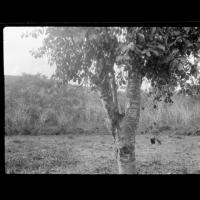
Manihot glazovii with Loranthus parasitic on it. Manihot forest in back and S... on hill behind. It is a luxuriant phase of the thorn forest type. [Shantz travel journal, Mar. 30, 1920]
Side of forest and vines

Side of forest and vine covered mt. at about 25 - mts. a little more luxuriant than the level land. [Shantz travel journal, Mar. 30, 1920]
Side of track

Detail of soil - Kizerawe, about 4 ft. red on top and a white soil below, weathered into ridges. Same [as previous image] on other side of track. [Shantz travel journal, Mar. 30, 1920]
Detail of soil
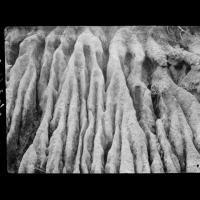
Detail of soil - Kizerawe, about 4 ft. red on top and a white soil below, weathered into ridges. Here I took a sample of the red over layer at a dept of about 2 ft. and the white soil at a depth of almost six or seven feet. These samples quite…
Euphorbia and dry forest
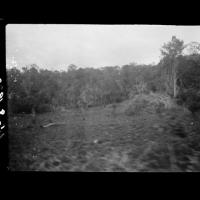
Euphorbia and dry forest on the hill back some distance - grass in the fore - a tree at the right. [Shantz travel journal, Mar. 30, 1920]
Open forest
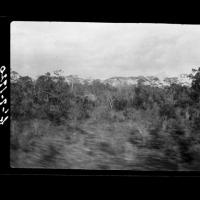
A more open forest and larger trees, looking straight - acacia like in the back. Soil uniform to 12 or 10 feet, where sandy roots penetrate. [Shantz travel journal, Mar. 30, 1920]
Detail of soil bank
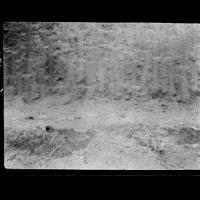
Detail of soil bank. Surface 6 [inches] to 1 ft. darker, a little is shown in the front. .. Typical soils are not as sandy as this. [Shantz travel journal, Mar. 30, 1920]
Grove of cocoanuts
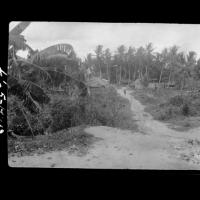
Shows a grove of cocoanut in back - banana at left and mango at right. This photo gives a fair idea of this country. [Shantz travel journal, Mar. 30, 1920]
Left side of track
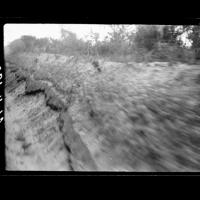
A second [view] looking back on left side of track.... Manihot gone wild here, has reseeded until the stand is very thick. [Shantz travel journal, Mar. 30, 1920]
Bananas
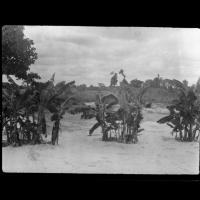
Bananas in fore, hut in the back - with tall grass, trees in the back. [Shantz travel journal, Mar. 30, 1920]
Soil bank

Soil bank, uniform reddish soil - with Manihot above, a dense forest - interspaced with native grasses and shrubs. Coconut palms grow here to some extent. [Shantz travel journal, Mar. 30, 1920]
Train

Shows train, our coach at the left. Mango trees are planted here along the line. [Shantz travel journal, Mar. 30, 1920]
Station, shows palm

At station, shows palm - split leaf and drooping fruit - also acacia like tree in back. [Shantz travel journal, Mar. 30, 1920]
Across river bed

Across a great river bed, only grass, palm on horizon. [Shantz travel journal, Mar. 30, 1920]
Sisal, cocoanut, kapok

Sisal, coconut, kapok. Kapok - great plantations - droughed [sic] off due to grasses. Trees about 3 meters apart. But now many dead. Sisal - suckering, going to seed and being chocked by grass. [Shantz travel journal, Mar. 30, 1920]
Sisal, mango, kapok

Sisal, mango, kapok. [Shantz travel journal, Mar. 30, 1920]
Kapok closeup
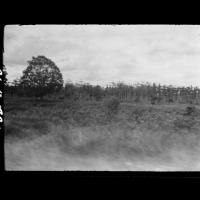
Kapok close up. [Shantz travel journal, Mar. 30, 1920]
Grassland with trees in back
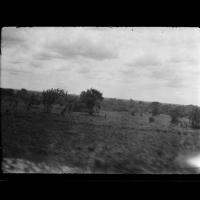
Open grass with scattered trees. [Shantz travel journal, Mar. 30, 1920]
Manihot, corn
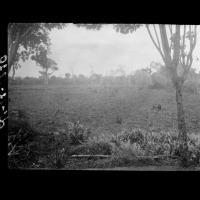
Large Manihot glaz[iovii] at side of track, corn growing in fore. Large baobab in back at left. Great [?] trees of clearing at the right. [Shantz travel journal, Mar. 30, 1920]
Sisal plantation

Sisal plantation in back - shows plants fruiting - from back. Plantation very windy. [Shantz travel journal, Mar. 30, 1920]