Browse Items (9335 total)
Sort by:
Grassland
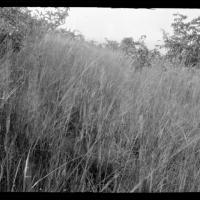
Stipa grassland. [Shantz travel journal, Mar. 27, 1920; note: caption in journal appears to be reversed with that of following image, substituted accordingly here]
Stipa grass and rubber like trees

Stipa grass and small rubber like trees. [Shantz travel journal, Mar. 27, 1920]
Bangwe island
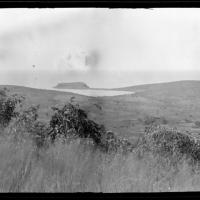
Point in back was at one time? Bangwe island mentioned by Stanley - How I Found Livingston: 479 as an island. It is now connected by a very low neck of land, certainly not over 10 ft. above the water line. As [previous image] with back lens off. …
Grass and shore
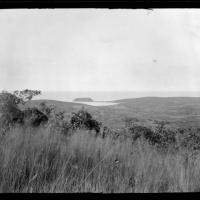
Point in back was at one time? Bangwe island mentioned by Stanley - How I Found Livingston: 479 as an island. It is now connected by a very low neck of land, certainly not over 10 ft. above the water line. [Shantz travel journal, Mar. 27, 1920]
Andropogon overgrown gun mounting

Andropogon overgrown gun mounting - Andropogon will give way to Stipa. [Shantz travel journal, Mar. 27, 1920]
Rocky, red soil and grass
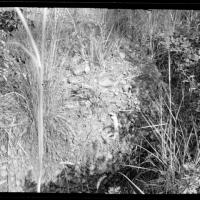
Rocky red soil to 6 ft., roots penetrate - shadow crossed at about 3 ft. Old trench. [Shantz travel journal, Mar. 27, 1920]
Old trenches and gun emplacement
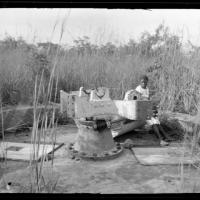
Old trench and gun emplacement - now grown over with Andropogon, and the small trees. [Shantz travel journal, Mar. 27, 1920]
Stipa grassland

Stipa grassland and a gravel rock soil - close up hill. [Shantz travel journal, Mar. 27, 1920]
An ant highway

An ant highway about 1/2 inch across - thrown up on either side. There is another at the left. These are used by a small black ant with a large fighting ant. [Shantz travel journal, Mar. 27, 1920]
Bunch of tall stipa

A single bunch of tall Stipa - a bunch by itself. With a graceful yellow brown feathery top. [Shantz travel journal, Mar. 27, 1920]
General view of shore
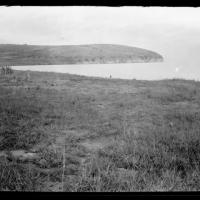
General view of shore below Kigoma. Taken about 10 ft. above the lake-shore, slopes very gradually. Rock in back shows high water line about 10 ft. to 15 ft. above the water line - with sloping soil or gravelly hills above the rock - could water…
Sweet potatoes

Sweet potatoes - detail of leaves. The corn cut and stacked - manihot an omnipresent crop, and sweet potatoes are important elements of the agriculture. [Shantz travel journal, Mar. 21, 1920]
Sweet potatoes

Sweet potatoes, several types of leaves, with a dhow. The Tanganyika and a large [boat] in the harbor. We went off on the Tanganyika. [Shantz travel journal, Mar. 21, 1920]
Amaranthus

Amaranthus as it grows about every cabin. [Shantz travel journal, Mar. 21, 1920]
Largeheaded Andropogon
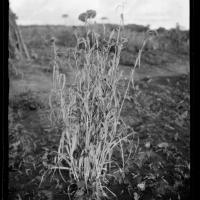
The large or congested headed Andropogon. Strong oil content and odor. Hung up in huts at times. [Shantz travel journal, Mar. 21, 1920]
Capsicum (red pepper)

A single plant of Capsicum, red pepper, [sketch 3 cm long] of about this size. [Shantz travel journal, Mar. 21, 1920]
Manihot, corn, beans
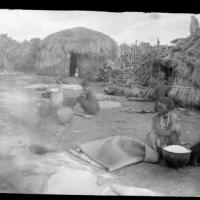
Manihot flour in fore, corn, beans. Grinding and pounding and sifting material. Corn in back. [Shantz travel journal, Mar. 21, 1920]
Hut Covered with Perennial Gourd
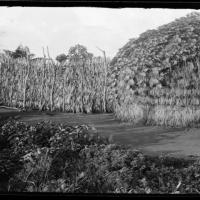
A photograph of a hut covered with perennial gourd. Corn can be seen in the back and to the side of the hut with amaranthus in the foreground.
Front side of corn fence
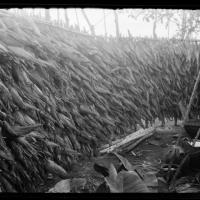
The front side of a corn fence, with Colocasia in fore and fermenting manihot in the background. [Shantz travel journal, Mar. 21, 1920]
Method of stacking corn
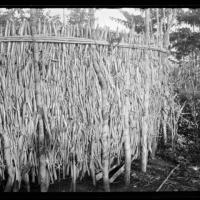
Shows method of stacking corn both for seed and for future use. This shows the back or stem side of the stack. Post and bamboo are used as a framework. Corn inverted with the husk on. A more general view. [Shantz travel journal, Mar. 21, 1920]