Browse Items (9335 total)
Sort by:
Method of stacking corn
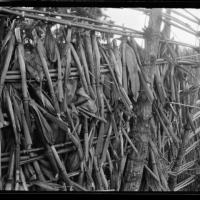
Shows method of stacking corn both for seed and for future use. This shows the back or stem side of the stack. Post and bamboo are used as a framework. Corn inverted with the husk on. [Shantz travel journal, Mar. 21, 1920]
Dry forest
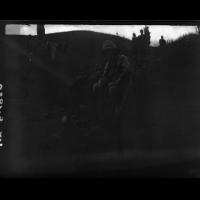
Verstappen and askari on mt. side. We came to the base of the mountain - at about 6 miles from Nyanza there is a strip of dry forest - not unlike that at Elizabethville or Kafue, but trees rather short. Our trip in was through a heavy rain. …
The woodseller
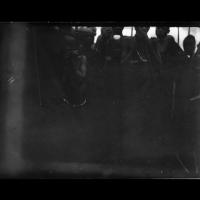
The wood seller - shows typical dress of natives - wood in bundles of fagots 1 ft. diam. [Shantz travel journal, Mar. 18, 1920]
Market
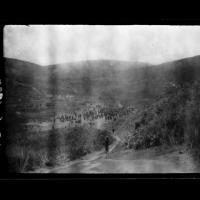
Looking down on the native market. [Shantz travel journal, Mar. 18, 1920]
Chief Mihare and his brother

A photograph of Chief Mihare with his tall brother-in-law and other indigenous people moving along a trail in a grassy hilly area.
Cloud masses and forests

On our way down we cleared the clouds at the top of the mt. and - shows cloud masses and forests shown on map. [Shantz travel journal, Mar. 18, 1920]
Shantz camp

Our camp with Shantz, Verstappen, Binga and his son Dagaswa. [Shantz travel journal, Mar. 18, 1920]
Bananas
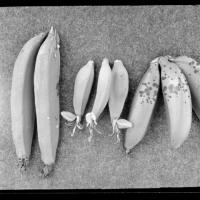
Bananas of types grown here - there are very few of the large ones. The short ones 4 inches long are abundant. It is the dominant type. The central ones are very young and are still flowers. Banana used to make pombe, the chief drink of this high…
Large yellow fruit
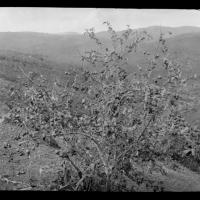
The yellow warty fruited Solanum. It is abundant and kept even in the center of the fields. Must be of use - said to be used as a salve or application, saw seed placed on top of child's head. [Shantz travel journal, Mar. 18, 1920]
Bananas
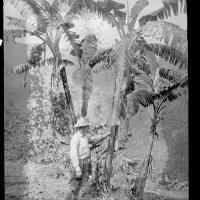
Bananas the chief crop, the Solanum at the left. Mts. in back. [Shantz travel journal, Mar. 18, 1920]
Ravine in grassland
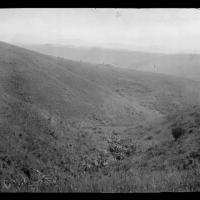
A ravine in the grassland & Rumex at left. Bananas and a coarse leather leaf Combretum, ferns Pteridium. Bananas grow as if native. [Shantz travel journal, Mar. 18, 1920]
Coarse grass
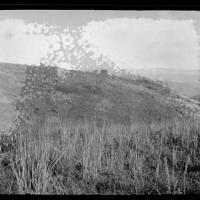
Coarse grass, large Andropogon in fore and in patches on hill in back. Bananas on hills and Binga chief's country on the hill in the back. [Shantz travel journal, Mar. 17, 1920]
Grass
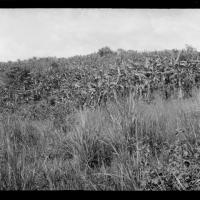
Grass in fore, mostly of herb 737 type. Banana plantations on hills, and at top. Hill under a cloud at back. [Shantz travel journal, Mar. 17, 1920]
Fig tree
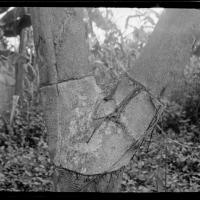
A fig tree showing where the bark has been removed to make bark cloth. The trees are not killed by this process - since the inner layer is apparently not taken. [Shantz travel journal, Mar. 17, 1920]
Charcoal being sold in market

Charcoal carried into market in packages made of grass. Wood is very scarce - and a great article in all this market. A cutlass in the back just got a franc matabish [?] from me. [Shantz travel journal, Mar. 17, 1920]
Oil palm market
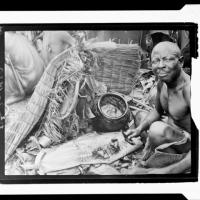
The oil (palm) market. Shawl put up to keep off the sun - and palm sold as a solid - a deep orange yellow color and scraped up in little piles. 2 heller per pile (44 heller per franc). [Shantz travel journal, Mar. 17, 1920]
Market scene
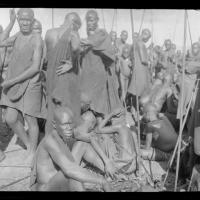
The meat market - retail. [Shantz travel journal, Mar. 17, 1920]
Market
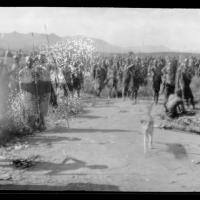
The market, N'gano - N'gano a mile beyond our camp. It is a typical native market on the top of one of the great hills. Held at 2:00 P.M. [Shantz travel journal, Mar. 17, 1920]
Market
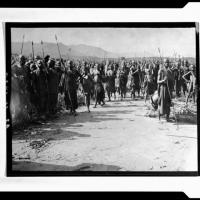
The market, N'gano - N'gano a mile beyond our camp. It is a typical native market on the top of one of the great hills. Held at 2:00 P.M. [Shantz travel journal, Mar. 17, 1920]
Banana field
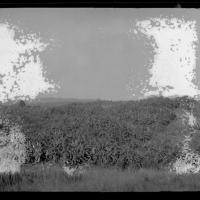
A banana grove on slope and at top of the hill. Grass in the fore. A large Rumex at the left. [Shantz travel journal, Mar. 17, 1920]