Browse Items (9335 total)
Sort by:
Largeheaded Andropogon
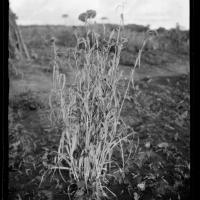
The large or congested headed Andropogon. Strong oil content and odor. Hung up in huts at times. [Shantz travel journal, Mar. 21, 1920]
Amaranthus

Amaranthus as it grows about every cabin. [Shantz travel journal, Mar. 21, 1920]
Sweet potatoes

Sweet potatoes, several types of leaves, with a dhow. The Tanganyika and a large [boat] in the harbor. We went off on the Tanganyika. [Shantz travel journal, Mar. 21, 1920]
Sweet potatoes

Sweet potatoes - detail of leaves. The corn cut and stacked - manihot an omnipresent crop, and sweet potatoes are important elements of the agriculture. [Shantz travel journal, Mar. 21, 1920]
General view of shore
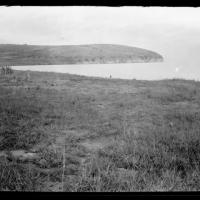
General view of shore below Kigoma. Taken about 10 ft. above the lake-shore, slopes very gradually. Rock in back shows high water line about 10 ft. to 15 ft. above the water line - with sloping soil or gravelly hills above the rock - could water…
Bunch of tall stipa

A single bunch of tall Stipa - a bunch by itself. With a graceful yellow brown feathery top. [Shantz travel journal, Mar. 27, 1920]
An ant highway

An ant highway about 1/2 inch across - thrown up on either side. There is another at the left. These are used by a small black ant with a large fighting ant. [Shantz travel journal, Mar. 27, 1920]
Stipa grassland

Stipa grassland and a gravel rock soil - close up hill. [Shantz travel journal, Mar. 27, 1920]
Old trenches and gun emplacement
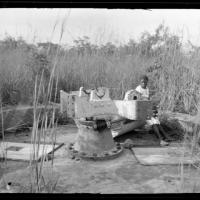
Old trench and gun emplacement - now grown over with Andropogon, and the small trees. [Shantz travel journal, Mar. 27, 1920]
Rocky, red soil and grass
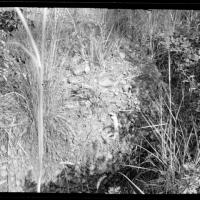
Rocky red soil to 6 ft., roots penetrate - shadow crossed at about 3 ft. Old trench. [Shantz travel journal, Mar. 27, 1920]
Andropogon overgrown gun mounting

Andropogon overgrown gun mounting - Andropogon will give way to Stipa. [Shantz travel journal, Mar. 27, 1920]
Grass and shore
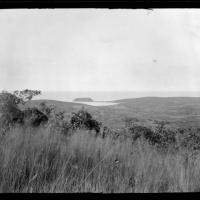
Point in back was at one time? Bangwe island mentioned by Stanley - How I Found Livingston: 479 as an island. It is now connected by a very low neck of land, certainly not over 10 ft. above the water line. [Shantz travel journal, Mar. 27, 1920]
Bangwe island
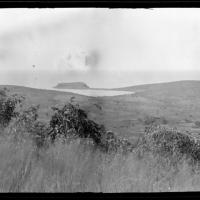
Point in back was at one time? Bangwe island mentioned by Stanley - How I Found Livingston: 479 as an island. It is now connected by a very low neck of land, certainly not over 10 ft. above the water line. As [previous image] with back lens off. …
Stipa grass and rubber like trees

Stipa grass and small rubber like trees. [Shantz travel journal, Mar. 27, 1920]
Grassland
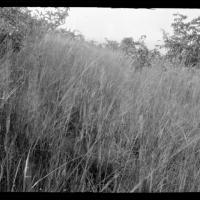
Stipa grassland. [Shantz travel journal, Mar. 27, 1920; note: caption in journal appears to be reversed with that of following image, substituted accordingly here]
Stipa grassland & bushes

Grassland & acacia like trees - bay and shore above island in back. [Shantz travel journal, Mar. 27, 1920; note: caption in journal appears to be reversed with that of previous image, substituted accordingly here]
Stipa grassland & bushes

Stipa grassland and bushes in fore - Kigoma in the back. [Shantz travel journal, Mar. 27, 1920]
Stipa shrub

Stipa shrub-cover with bay of Kigoma in the back. On the alluvial bottom soil the tall Andropogons predominate. But on the gravel the tall Stipa like grass, an open bunch grass. [Shantz travel journal, Mar. 27, 1920]
View of V.E. Payne grounds

A view in the grounds of V. E. Payne (Kigoma, East African Agency). A walk bordered by banana, papaya and the large red bean vine. [Shantz travel journal, Mar. 27, 1920]
Papaya tree
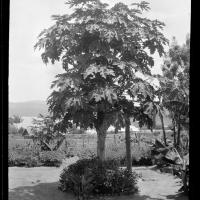
Papaya tree - much branched with fruit at the ends of the branches. [Shantz travel journal, Mar. 27, 1920]