Browse Items (9335 total)
Sort by:
Soil profile

Panorama - shows Ena falls at right and Ndungu falls at left - with Kere Mere Mt. at left. Shows agriculture on steep slope. Also type of vegetation in this hilly country. The natives are Embu. [Shantz travel journal, May 3, 1920; 1 of 6]
Soil profile

A photograph of a soil profile, which is typical of water sheds. There is a dark layer of soil closer to the top and red soil below.
Soil profile

A photograph of the surface soil with dark chocolate rock beneath lighter.
Soil profile

A photograph showing detail of soil changes with heavy soil at the top of the photograph, then 1 foot of gravel with clay and light spots below.
Soil profile

A photograph of a soil profile. It is dark and heavy to a depth of three feet., then lighter and more gravel at 3 feet, with a chalk-like deposit at the bottom 4 to 5 feet.
Soil profile

A photograph of a soil bank at the Sundays river. The first 5 feet of soil is red and below that the soil is white.
Soil of the high veld

A photograph of the soil of the high veld. The surface is thrown up abut 8 inches above the actual soil surface. The surface foot is chocolate colored, then at the second foot it becomes more reddish. This red character of the soil increases and it…
Soil just planted
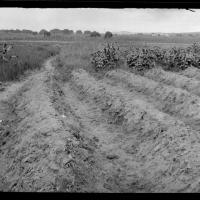
Ribbed fresh soil just planted in manihot. Beans at the left. Peanuts, corn, mangoes, hills and mangoes in the back. [Shantz travel journal, Mar. 28, 1920]
Soil dark reddish brown

Soil dark deep reddish brown with Andropogon and trees above. [Shantz travel journal, May 8-11, 1920]
Soil cut from bank

A photograph showing the detail of bank at the mission coffee fields, where soil samples were taken. Holes from which samples were taken can be seen in the bank.
Soil cut down

A photograph of soil cut down to form RR grade. This cut is about 6 feet deep to perhaps 3 feet in the shallowest place. The soil below looks like rock, but is red hard clay. It is soil in situ.
Soil cut down

A photograph of soil cut down to the rock base with an occassional mass of soil left standing. The photograph was taken long after dark and given long exposure.


Soil bank, dark red brown

Soil bank - dark red brown - Combretum, Themeda etc. [Shantz travel journal, May 8-11, 1920]
Soil bank

A soil bank - shows soil to 6 ft. with root penetration - typical Andropogon tree grass savanna - soil take ... at about 2 ft. slightly darker than above. This is typical. [Shantz travel journal, May 2, 1920]
Soil bank

Soil bank 4 ft. deep in fore - grasses above with scattered trees and the Bohma in back. [Shantz travel journal, Apr. 15, 1920]
Soil bank

Soil bank in fore - darker at surface foot, reddish becoming lighter below. Sisal above with trees growing up above sisal, just beyond. [Shantz travel journal, Apr. 11, 1920]
Soil bank

Soil bank, uniform reddish soil - with Manihot above, a dense forest - interspaced with native grasses and shrubs. Coconut palms grow here to some extent. [Shantz travel journal, Mar. 30, 1920]
Soil bank

A photograph of a soil bank, a gravelly grey soil with the upper foot being darker. Above the soil bank is a grass area and shrubs.